
Sexual Assault Protection Order Case Review
“…this person continues direct and indirect stalking and harassing by monitoring myself and husband to intimidate at work and local area. I don’t feel safe.”
— SAPO petitioner/survivor
Findings & Opportunities for Action and Change from Sexual Assault Protection Order (SAPO) Case Review
held on Tuesday, May 5, 2026
Justice for Families Project
Published June 2026
This project was supported by Grant No. 15JOVW-24-GG-00060-JFFX awarded by the Office on Violence Against Women, U.S. Department of Justice. The opinions, findings, conclusions, and recommendations expressed in this publication/program/exhibition are those of the author(s) and do not necessarily reflect the views of the U.S. Department of Justice.
For more information, please contact Nikki D’Onofrio, Justice for Families Project Manager, Bellingham-Whatcom County Commission on Sexual & Domestic Violence: ndonofrio@dvcommission.org
The SAPO case review team read summaries of the court record for nine selected Sexual Assault Protection Orders (SAPOs) filed in District Court from 2022 – 2025. SAPOs were selected for the review to provide examples of various outcomes and fact patterns. Each summary included the information from the docket notes as well as documents and hearing recordings that were available and thus had varying amounts of detail.
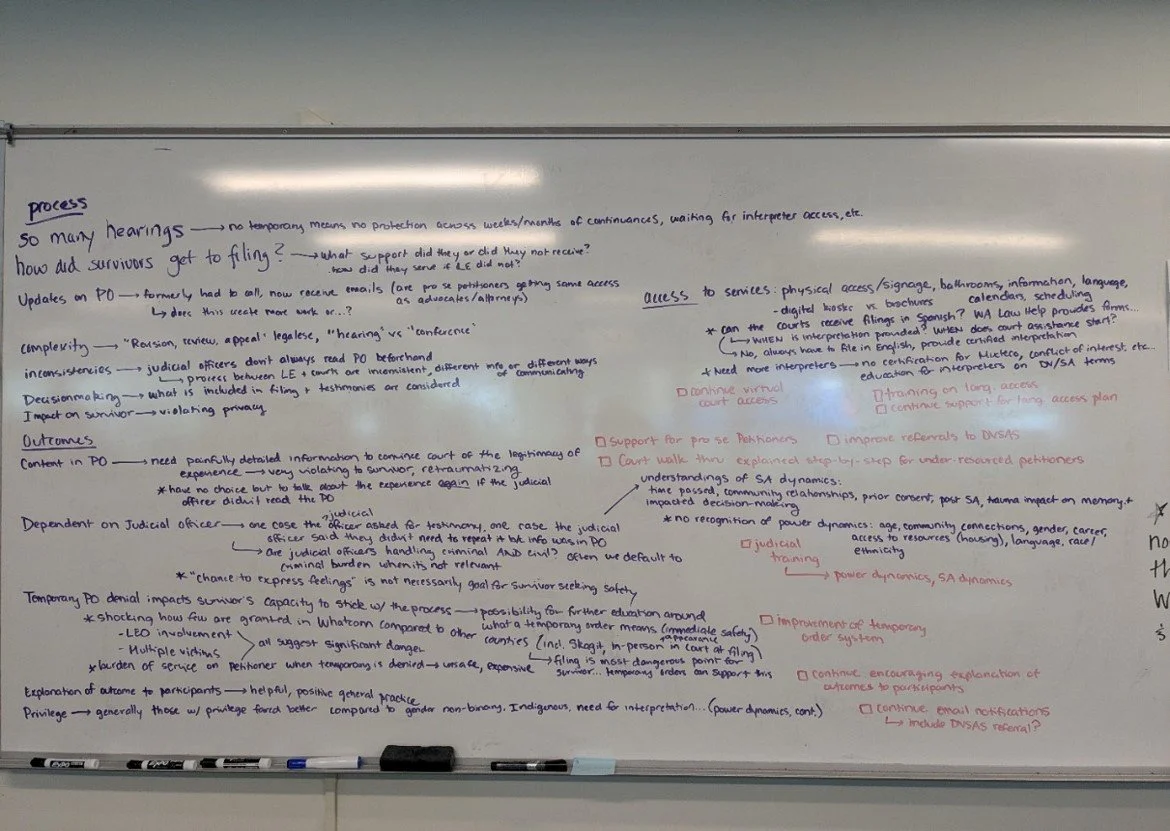
Photograph of a white board with notes from the case review team's discussion written in red and blue markers.
Strengths in District Court
“I’m scared of going to court.” —SAPO petitioner/survivor
District Court administration has been willing to provide information about protection orders filed in their court. District Court provided all documentation within a week of a request for this information and has been open and responsive to follow up requests and questions. Information provided included:
•data on filings, orders denied, and orders granted,
•docket notes,
•petitions,
•submitted paperwork such as affidavits, motions, and evidentiary records,
•participation in the case review to offer information and receive feedback
District Court has put in place electronic communications that make the process more accessible for petitioners/survivors, including:
•Emailing a petitioner and/or their attorney, if email is available, to let them know if the temporary petition has been approved or denied, and to give them information about service and hearings.
•Emailing all protected parties/survivors 90 days in advance of when their final order is set to expire and attaches an application for extension.
•Providing a zoom link on the packet for protection order hearings.
District Court judicial officers use best practice language from judicial bench cards to open and close hearings; this language includes:
•Defining the standard of preponderance of evidence that is needed for a civil protection order.
•Stating how “consent” and “sexual assault” are defined in the protection order statute.
•When a final order is denied, speaking clearly with respondents to let them know that though the order was not granted, the respondent is on notice that the petitioner does not want any contact.
District Court has been willing to share their Language Access Plan for review by and feedback from a national technical assistance provider, Asian Pacific Institute on Gender Based Violence (API-GBV), to improve meaningful language access for survivors.
Opportunities for Action and Change
“Since the night of my assault, my life has changed. I am a completely different person… I feel unsafe leaving my home or even going outside.”
- SAPO petitioner/survivor
The Commission on Sexual & Domestic Violence is a recipient of a 3-year, $600,000 grant from the U.S. Department of Justice, Office on Violence Against Women, Justice for Families grant program. The funding supports the Commission, DVSAS, LAW Advocates, and training and technical assistance needs; Whatcom County District and Superior Courts are also project partners.
Justice for Families grant goals are to:
Improve civil and family court processes to be accessible, easy to navigate, trauma-informed, and procedurally just for survivors of domestic violence, sexual assault, and stalking.
Create welcoming, standardized, and clear civil court processes to achieve language access for survivors for whom written and spoken English is not their first language.
The Justice for Families grant supports our community capacity to achieve the opportunities for change and action described below. The Commission on Sexual & Domestic Violence will be responsible for initiating all activities listed under “how to address,” below.
Increase approval rates of temporary orders by generally reinstating the daily ex-parte hearing calendar for temporary order review.
Why?
Whatcom County is unique in the State for having very high rates of denial for temporary protection orders (SA and DV). Denying a temporary order puts petitioners/survivors at risk during what is often the most dangerous time for them—when they are leaving a relationship and/or letting the respondent/offender know that the legal action has been started against them. The burden of requiring a respondent to stay away from a petitioner for two weeks is lower than the burden of a petitioner to have to increase safety planning (instead of focusing on hearing preparation) due to the increase in risk and danger. Denying a temporary order also means that the petitioner/survivor is responsible for service of the order and must pay for that. Furthermore, denial of an order means that there is no protection for the petitioner/survivor when there are continuances and delays.
How to address?
Meeting with District Court presiding judge.
Ensure all judicial officers (judges, commissioners, and pro tem) have regular and sufficient training in the following areas:
•Dynamics of sexual assault, power and coercion, and myths and misconceptions about sexual assault and consent
•Neurobiology of trauma and trauma responses (fight, flight, fawn/appease, freeze, fine, faint), with particular attention to fawn and fine responses
•Experience of pro se petitioners with limited experience with legalese, legal system, trials, and legal paperwork (and increased burden on petitioners who may be unhoused, Native, LGBTQ+, and/or without community support)
•Implicit bias and interrupting bias in the courtroom
•Standard of preponderance of evidence in civil SA protection orders (what evidence or statements can be used to meet this standard)
How to address?
Meeting with District and Superior Court presiding judges to make plans for initial training for judicial officers and to make a plan for ongoing training. Meeting with consultants who will provide judicial training to share these areas of focus.
Identify a system within the Court and then appoint attorneys for pro se petitioners/ survivors when the respondent has an attorney.
How to address?
Meeting with District and Superior Court presiding judges. Quarterly meetings with court administrators, advocates, and civil legal aid.
Improve access to DVSAS advocacy and support by providing specific information on what DVSAS can help with as a handout at the front desk at District Court, and as an attachment to emails that District Court sends to petitioners. Maintain the civil legal advocate position hosted at the courthouse and increase DVSAS’s open office/drop-in hours.
How to address?
Quarterly meetings with court administrators, advocates, and civil legal aid.
Achieve meaningful language access and disability access throughout the court process, including getting information, filling out forms, navigating the courthouse, and participating virtually.
This can occur through review of the county’s language access plan, training for judicial officers, training for interpreters, training for bilingual advocates and service providers, and reviews of community support agency language access plans, all in consultation with grant technical assistance providers who have expertise in these areas.
What are examples of what needs to be addressed?
Courthouse signage throughout the building, updates to website with clear language, protection order kiosks at the courthouse and/or other locations throughout the county, laptops at locations throughout the county to be used for virtual access, wheelchair access, translation of documents and petitions for people who can’t fill them out in written English, and number of qualified and certified interpreters.How to address?
Quarterly meetings with court administrators, advocates, and civil legal aid. Technical assistance from the Asian Pacific Institute on Gender Based Violence (API-GBV), Abused Deaf Women’s Advocacy Service (ADWAS), and Wandke Consulting.Develop clarity on the preparation that is expected of all judicial officers in advance of a hearing (e.g. the petition, response, and all supporting documents should be reviewed in advance).
How to address?
Meeting with District and Superior Court presiding judges.
Tracking and Assessing Change
“…after he left the room, I laid on the couch crying feeling yet again vulnerable and abused and useless…” —SAPO petitioner/survivor
The Commission on Sexual & Domestic Violence will:
For all quarterly meetings with court administrators, advocates, and civil legal aid and for all meetings with District and Superior Court presiding judges, develop a system to track:
•Meeting date, agenda items, and discussion notes
•Follow up tasks with responsibilities and deadlines
•Decisions/changes that are made to improve outcomes for survivors
Develop a plan to receive feedback from judicial officers after training. The feedback could include training evaluations, pre and post tests, or other means. Compile all feedback to use in future and follow up training opportunities.
Collect and compile data annually, noting trends as able (given limited sample sizes), on the following:
•SAPOs filed, temporary orders granted, and final orders granted.
•Numbers of people seeking DVSAS, Lummi Victims of Crime, and WWU Survivor Support Services support for civil sexual assault protection orders.
Develop systems for understanding accessibility and safety in processes and outcomes of sexual assault protection orders through regular opportunities such as:
•court watch
•case reviews
•petitioner feedback forms
•courthouse audits
•survivor interviews
For more information, please contact:
Nikki D’Onofrio
Justice for Families Project Manager
Bellingham-Whatcom County Commission on Sexual & Domestic Violence
ndonofrio@dvcommission.org